
Beyond the Toolkit: The 5 Mindsets Essential for Transformative Social Innovation

For practitioners tackling today’s complex social challenges, there is a natural temptation to leap from conceptual models to structured toolkits. However, deep social transformation cannot be achieved through rigid adherence to process alone. Powerful innovation relies heavily on the internal dispositions - the mindsets - that people bring to the table.
At ThirdStory, our practice is built on the understanding that powerful innovation requires more than just a way of 'doing'. It demands a fundamental way of 'thinking' and 'being'.
The Origins of the Mindsets
Our Social Innovation Mindsets were originally developed by Innovate Change in Aotearoa before its merger with Innovation Unit (now ThirdStory). They arose from a distinct trend in the sector: an increasing preoccupation with practical tools, contrasted by a noticeable lack of emphasis on what we need to believe and how we need to think to make this work truly transformative. To ensure design has a lasting systemic impact, we anchor our work in five core mindsets. The mindsets also feature dual namings, given their Aotearoan origins.
The 5 Social Innovation Mindsets
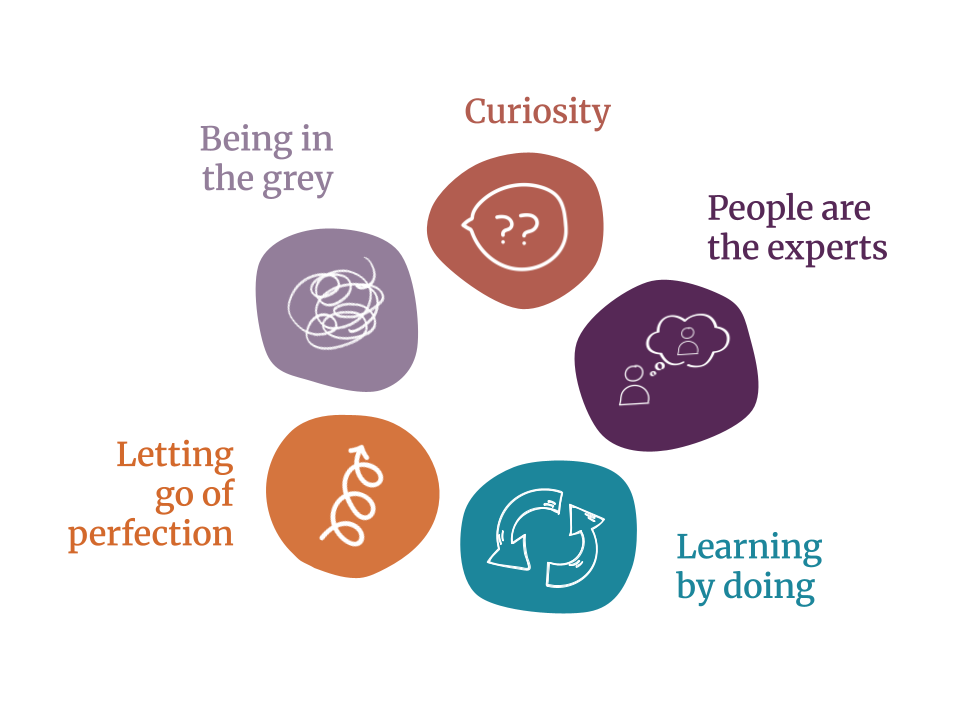
1. Curiosity (Whaowhia te kete mātauranga)
Curiosity is defined as an unwavering desire to know more, requiring practitioners to actively dismantle the burden of pre-existing expertise. It is common to rely on historical experience to assume we understand a cohort or an issue. True curiosity demands that we challenge what we hold to be true, ask creative, thought-provoking questions, and remain open to being fundamentally changed by what we observe and listen to.
2. People Are the Experts (Rangatiratanga - He aha te mea nui o te ao, he tangata, he tangata, he tangata)
This mindset operates on the foundational belief that individuals understand their own lives better than any external practitioner. When the needs and values of communities are placed directly at the centre of design, the resulting solutions are significantly more viable and sustainable. By executing projects with communities rather than to them, professional power dynamics are rebalanced, and the individuals affected become the primary authors and advocates of the solution.
3. Learning by Doing (Ako - Mā tini mā mano ka rapa te whai)
Learning by doing represents a preference for rapid action, prototyping, and experimentation over prolonged advisory committees and circular discussions. Taking a conceptual idea straight to large-scale implementation introduces immense financial and relational risks. Alternatively, low-cost prototyping allows teams to test assumptions early, generate immediate learning, and pivot or discard unviable concepts before there is too much at stake.
4. Letting go of perfection (Ehara te tino tika i te otinga)
Social innovation asks us to try new approaches without knowing exactly how they will unfold. The professional stigma surrounding failure often paralyses project teams. Looking at perfection differently helps us accept that not all ideas will work, but trying them anyway to learn what we can. Embracing this mindset requires separating personal ego from the project and acknowledging the learning along the way. By aiming for small, contained failures through early testing, we de-stigmatise errors and treat them as essential steps toward a functional solution.
5. Being in the Grey (Kia noho tau i te rangirua)
Tackling complex, systemic issues like poverty or housing insecurity requires a high tolerance for ambiguity. When faced with overwhelming uncertainty, organisations frequently leap to premature simplification or pull from a familiar deck of historical solutions simply to regain a sense of control. Being in the grey allows practitioners to resist obvious answers, adopt a beginner's mind, and explore profound systemic innovation rather than mere incremental adjustments.
The Impact on Our Work
These mindsets show up in our day-to-day work across Australia, Aotearoa New Zealand, and the Caribbean. Each of our team members embodies these mindsets in our own unique ways. We help individuals and teams develop these social innovation mindsets through the experience of participating in projects.
We also support organisations and systems to build conditions to allow these mindsets to flourish. As our Social Design Academy Australia participants explained in our 2025 program,
“Building individual comfort with working in these ways is one thing, but there can be additional challenges if you’re working in a culture that isn’t aligned, or even contradicts, these mindsets.”
By embedding these mindsets into our methodology, we build robust social connectedness and cultivate genuine empathy between professionals and communities. Ultimately, shifting the focus from rigid toolkits to active ways of being ensures that our social innovation efforts deliver robust, meaningful, and community-owned solutions that stand the test of time.