
Patterns and Progress: One Year as ThirdStory
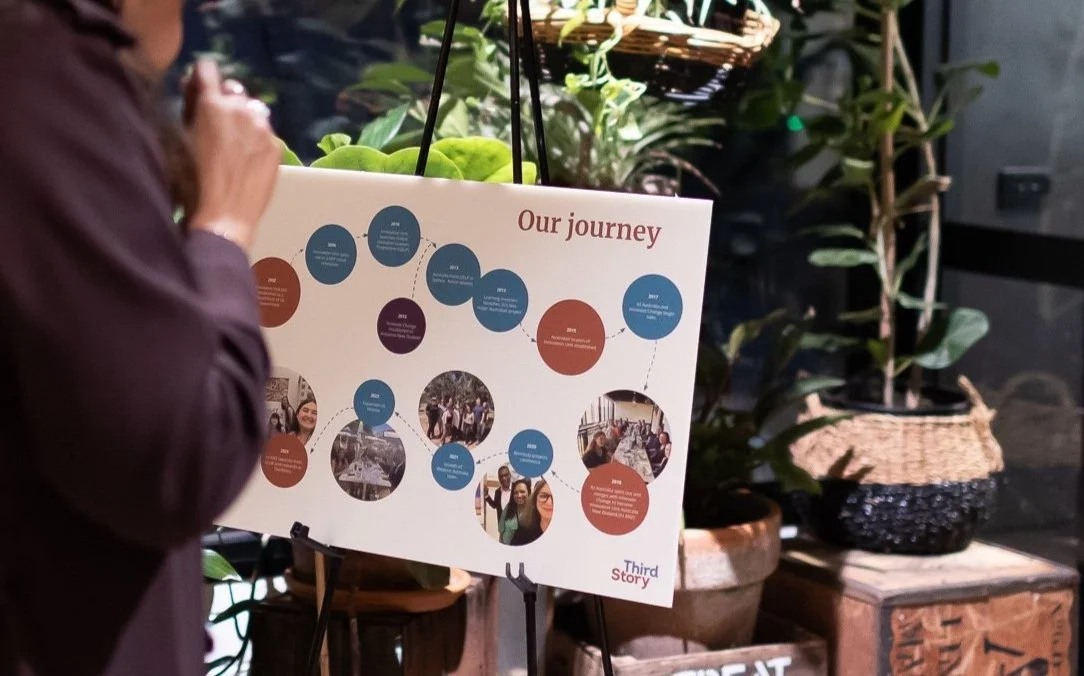
One year ago, we launched ThirdStory with a clear intention. To work alongside people, communities and organisations to help the messy work of change take hold. Our Chief Executive and Founder Keren Caple reflects on one year of progress.
Across the areas we work in, there is no shortage of effort. People with lived experience understand the challenges deeply, communities are already responding, organisations are working hard to deliver support and systems continue to evolve, often under pressure.
What is less common is connection. Insight doesn’t always travel, work happens in parallel, and learning is often held in one place, rather than shared and built on. In the year since we separated from our sister organisation and became ThirdStory, we’ve been paying close attention to what starts to shift when those connections begin to form.
The magic of influence
This is evident in the continued development of This is Manly. What began as a campaign has grown into something more, something embedded within communities. The focus has shifted toward the everyday influence people have in their own networks, and how that can be used to shape attitudes and behaviour. What is emerging is less about messaging and more about participation. A form of prevention carried within communities rather than delivered to them.
Connecting people, ideas and energy
Through the Social Design Academy, we have continued to work with individuals and organisations navigating complex challenges in real time. The third Australian cohort that completed the program this year are working on issues including youth homelessness, family and domestic violence, regional development and energy transition. These are all important social policy areas, however, what matters most is what happens in the space in between the formal curriculum. People who would not usually work together are learning side by side and continuing that work in their own contexts. As this work extends into Bermuda and Aotearoa, something else has become visible, that while the contexts differ, many of the underlying patterns do not.
Learning with and from those deep in the messy work of change
At a systemic scale, we have continued to work with partners to strengthen how organisations connect and learn from each other. In December 2025, we began a new phase of work with Paul Ramsay Foundation and Aboriginal consultancy Kaarla Baabpa, supporting 17 collaborations focused on family-centred responses to domestic and family violence in Queensland, Western Australia and the Northern Territory. This builds on our convening of 31 services supporting special cohorts of help-seekers to shape field-level recommendations for funders and policymakers. Across both phases, another consistent pattern is emerging. When organisations are supported to learn together, they are better able to respond to the complexity of people’s lives. The work begins to shift from individual services toward something more connected and even more powerful.
Supporting the most promising approaches to grow and evolve
This year has also marked a transition point in Bermuda, where a long period of work focused on transforming a nation’s public education system in partnership with communities has come to a close. A significant focus has been on capturing what has been learned and making it usable beyond the life of the work itself. That process has reinforced another pattern we see across all of our work. Progress depends on how well learning moves. It needs to move from lived experience into practice, from practice into decision-making, public policy and governance, and between places, adapting as it goes.
Seeking out patterns
Working across multiple communities and geographies has made this clearer. It has created a discipline for us. You can’t assume that what works in one place will transfer directly to another. At the same time, patterns begin to emerge for us as we deepen our Story for Change. Ideas travel, approaches are tested and reshaped and the work becomes less about applying a model and more about strengthening the flow of learning between places. Working across places sharpens our ability to recognise those patterns and to carry ideas between contexts in ways that still fit locally.
Looking across the year, what stands out is not any single project, but what has started to shift as connections take hold. Work shaped with people in their own context carries further. When communities are part of the work, it becomes more durable. When organisations are connected, they respond more effectively. When learning moves between places, it builds rather than resets. This is where our work sits. In the connections between people and communities, between organisations, between places. In helping learning move, take shape and be used.
As we move into our second year, this is where we will continue to focus.
It might not be your anniversary but it’s always a good time to reflect. Where are the connections in your work that could carry further, if they were made visible and supported? And what kind of support would make the greatest difference for you?
If you’d like to learn more about how we support organisations to involve everyone who needs to be part of the change, get in touch with us at team@thirdstory.org and let’s have a conversation.