
Providing a communications lifeline to communities in times of crisis
How might we bridge the gap when traditional infrastructure fails so that communities can connect following a natural disaster?
When executives from a leading Australian homewares company experienced a natural disaster first-hand, they asked themselves what their organisation could do to fill gaps in emergency provision.
Following bushfires in their Victorian communities, they noticed one significant issue that caused communities even more stress on one of the worst days of their lives. Those affected were often not able to let their loved ones know they were ok or contact banks, insurance and other essential services due to power and telecommunications outages.
With our support, they set out to see if they could bridge the gap when traditional networks fail, providing a lifeline to communities in need of communication support while telecommunications carriers work to reinstate services in disaster-affected areas.
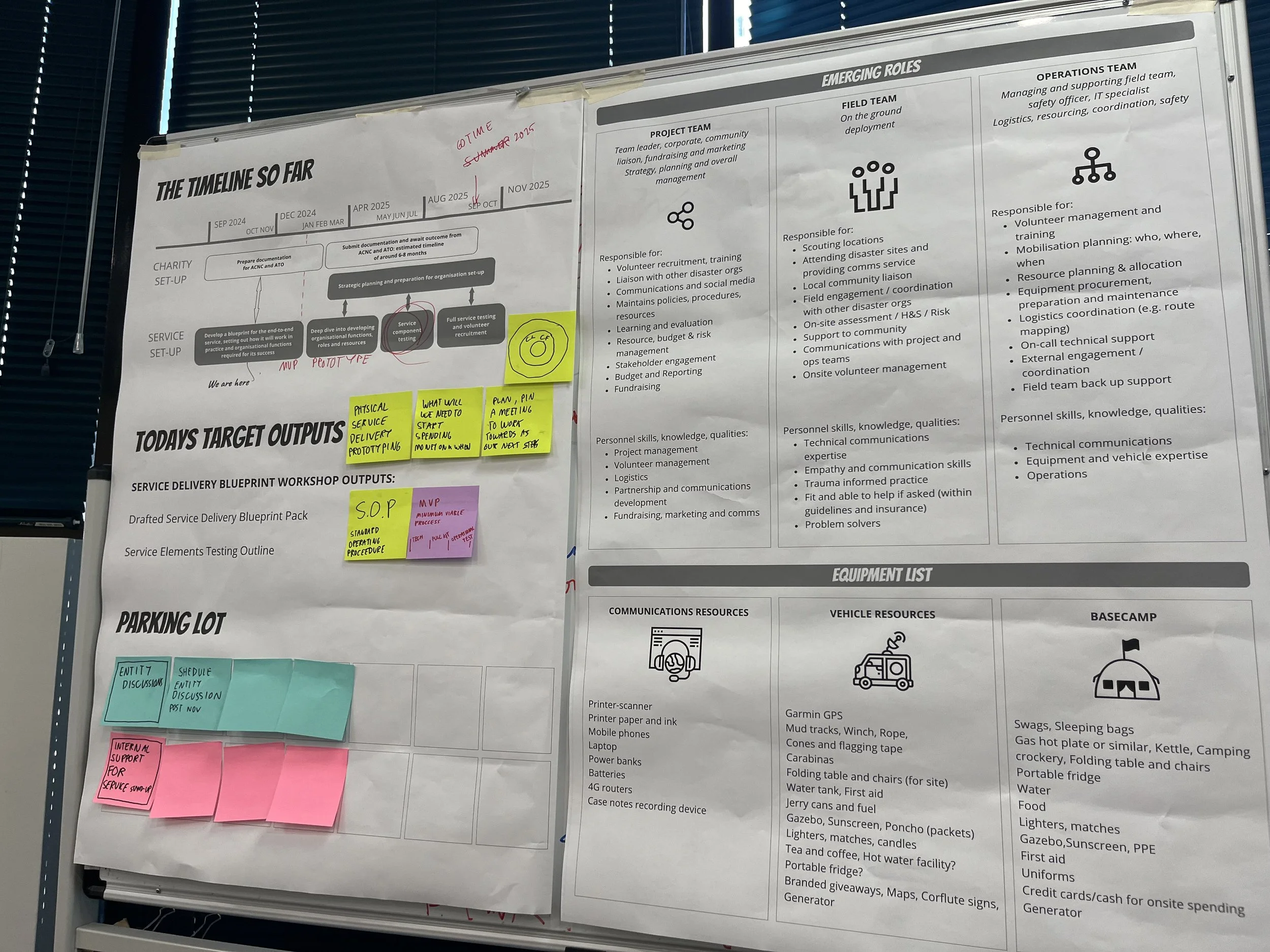
Our challenge was twofold: design a service to enable Australians affected by natural disasters to access communications and other essential services, and develop the foundations of a charitable organisation that could fund and govern it.
Developing a disaster response and resilience service model
In consultation with disaster relief organisations and experts, we designed a service that aims to mobilise quickly and arrive at the scene of a disaster once an area has been safe to enter by local emergency organisations. The service, proposed to be contained within a fitted-out vehicle and trailer, offers satellite internet access, printing and photocopying, use of equipment that might have been lost in the disaster such as phones and laptops, and an area for locals to gather for a coffee and a yarn while they access the internet.
The service development included:
Phase 1: Research
We undertook a review of evidence and insights about the challenges communities faced most acutely during natural disasters that we had the capacity to address. We learned that during natural disasters, outages on mobile phone and broadband networks are commonplace as communities lose power or infrastructure is damaged. Mobile phone towers typically have backup generators with enough fuel for around 10 hours of service - but if fires or floods block access to towers, technicians are unable to bring more fuel to stations to top up generators. Some communities often have to wait significantly longer than 3.5 days for access to phones and internet to be restored.
“Communities were isolated, experiencing extended periods without power, communications, and ready access to essential goods and services, or access to cash or EFTPOS to pay for their most basic needs.”
In times of disaster people need access to phone and internet to seek help, let people know they are safe, use banking and payment systems, and apply for emergency payments on offer from state and federal governments. When mobile telecommunications are down, Australians are unable to make phone calls to loved ones, insurers, and support services, dial 000, access the internet to apply for emergency payments, use EFTPOS facilities and sometimes are unable to pump fuel. As a result of this phase, we developed an insights report and a high level service concept to test out.
Phase 2: Concept testing
We then engaged with a national disaster response organisation to better understand what happens ‘on the ground’ immediately after a natural disaster. We wanted to learn more about the different roles federal, state and local agencies play in responding to a disaster, who makes decisions about whether an area is safe to enter, how decisions are communicated, and what challenges or opportunities professionals in this sector see with our service concept.
Phase 3: Service design
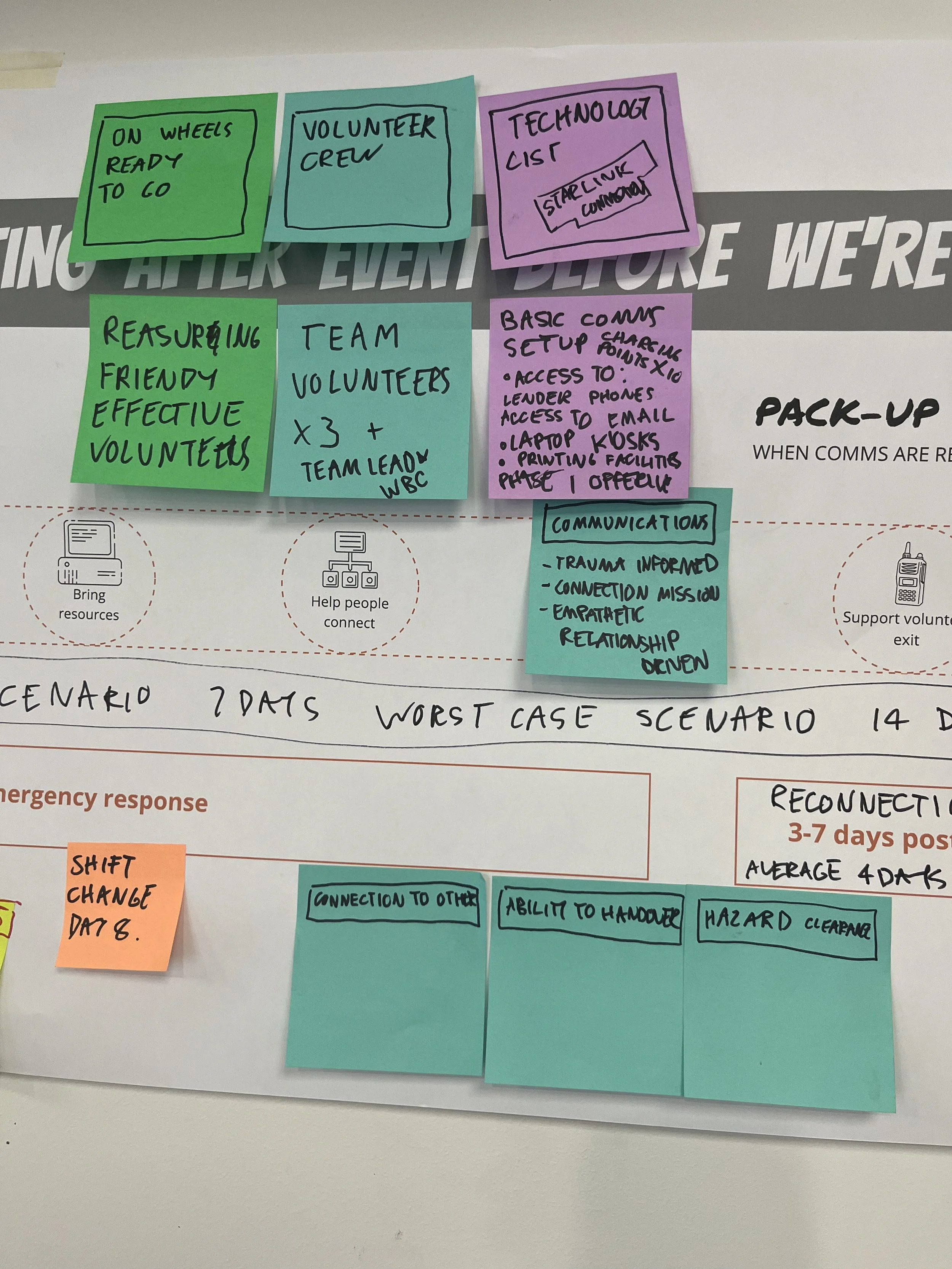
Drawing on the insights and feedback we uncovered, we held a service development workshop with company representatives and a responder from the national disaster response organisation to build a service blueprint. The blueprint set out each stage of the service, the ‘frontstage’ experience of community members as they discover and engage with the service, the ‘backstage’ activities that a supporting organisation would need to perform in order to provide the service, and the systems and processes required to enable the work.
Scoping how a charitable organisation might fund and support the service
During Phases 1 and 2, we also worked with the company and lawyers to explore how a service of this kind could be operated and funded. We developed a proposition for how a charitable enterprise could be structured, and a timeline and process for registration. This included the application process for charitable status from ACNC, and DGR designation with the ATO so that donations could be tax-deductible. This led us to Phase 4:
Phase 4: Business modelling
Our service looked good on paper, but we needed to make sure it could be made viable. Using the service blueprint we developed a budget for the first five years of operation, taking into account initial set-up costs and capital expenditure, 1-2 years of service testing and refinement, operaturing expenditure for years 2 to 5, and employee costs. We also undertook a review of potential funding sources the charity and service might be eligible for on top of the donation committed by the company.
The company is now considering the service blueprint and business model in order to form its next steps.